 Lahore 23°C
 Karachi 29°C
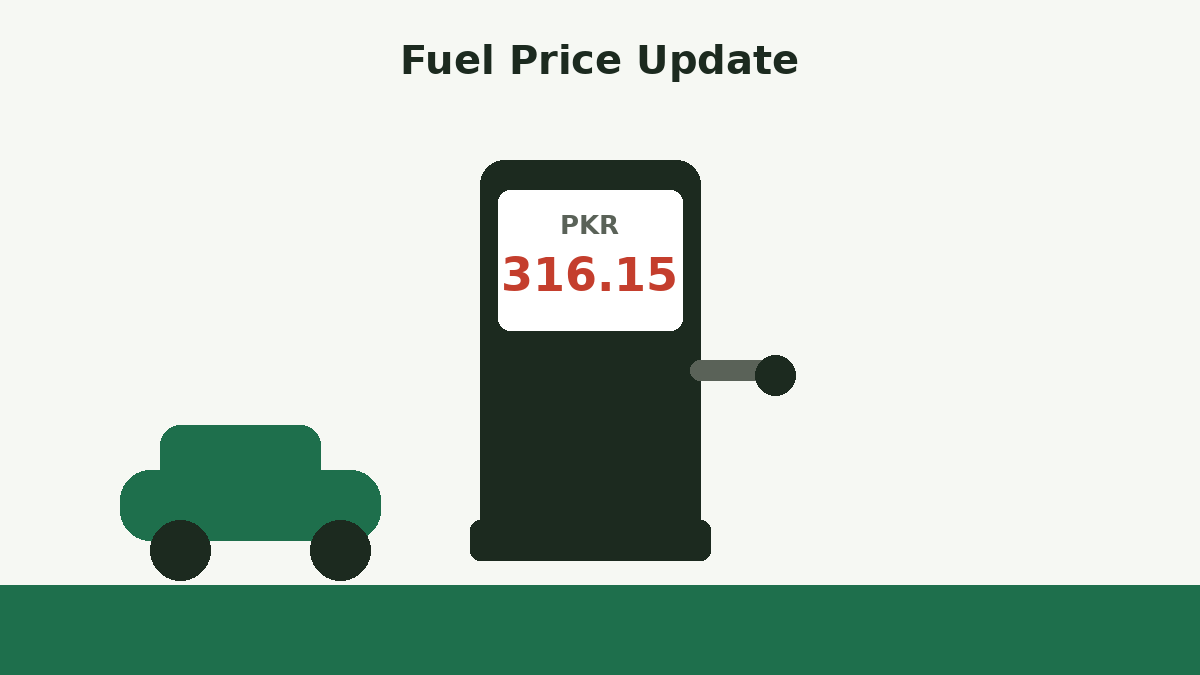
Pakistan has raised the price of petrol by Rs5.44 to Rs316.15 per litre, while high-speed diesel has increased by a much sharper Rs31.05 to Rs354.35 per litre.
The revised rates took effect on July 18, 2026. Although the government has announced a transition towards daily petroleum pricing, the first notification under the new arrangement reportedly applies until July 20. This suggests that the operational details of the daily system are still being implemented.
The government says daily revisions will make fuel pricing more transparent and allow changes in international markets to reach consumers more quickly. But the central question remains:
Will daily pricing transmit reductions as quickly as increases, or will it simply transfer global oil volatility directly to Pakistani consumers?
Why the diesel increase matters more
The rise in petrol will immediately affect motorists, motorcyclists, rickshaw drivers and ride-hailing users. However, the Rs31.05 increase in diesel may have a broader impact on inflation.
High-speed diesel powers much of Pakistan’s road freight, intercity transport, agricultural machinery and commercial backup generation. A higher diesel price therefore enters the cost of moving food, construction materials and manufactured goods around the country.
Consider a transporter purchasing 300 litres of diesel:
300 litres × Rs31.05 increase = Rs9,315 additional cost
That is the effect of only the latest increase. A business using 3,000 litres would face an additional fuel expense of Rs93,150 at the same consumption level.
Transport companies are unlikely to absorb such increases indefinitely. Part of the additional cost will eventually be passed to wholesalers, retailers and consumers.
The unfairness is that price increases move through the supply chain quickly, while reductions rarely reverse earlier increases completely. A vegetable supplier may raise delivery charges after diesel becomes more expensive, but those charges do not automatically fall when diesel later declines by several rupees.
Why prices have increased
The government has linked the decision to renewed instability in the Middle East and rising international petroleum-product prices.
Petroleum Minister Ali Pervaiz Malik said Pakistan was experiencing increases in international benchmarks for refined petrol and diesel. These benchmarks can matter more to the retail calculation than simply looking at the headline price of Brent crude because Pakistan imports and prices refined petroleum products through a broader formula.
The final pump price may be affected by:
- International petrol and diesel benchmarks
- The rupee-dollar exchange rate
- Import premiums, insurance and freight
- Customs duties
- Petroleum and climate-related levies
- Inland transportation costs
- Dealer and oil-marketing-company margins
This means international crude oil could decline on a particular day while Pakistan’s effective import cost remains elevated because refined-product prices, shipping charges or the exchange rate have moved differently.
However, the complexity of the formula also creates an accountability problem. Whenever prices rise, the public is told that international conditions made the decision unavoidable. Yet consumers are rarely shown a simple calculation explaining exactly how each component contributed to the final price.
Is daily pricing really based on today’s market?
Under the announced mechanism, daily prices will reportedly be calculated using the average Platts benchmark from the previous seven working days. The government says increases and decreases will then be passed on without requiring repeated political approval.
Using a seven-day average can prevent one unusual trading day from producing an extreme retail-price change. But it also means the system is not a direct reflection of today’s oil price.
For example, suppose international petrol prices fall sharply today. The earlier, higher prices would remain part of the seven-day average for several more days. Pakistani consumers may therefore receive the benefit gradually rather than immediately.
That does not necessarily make the formula wrong. But the government should not create the impression that every international decrease will appear fully at petrol stations the following morning.
Transparency requires more than publishing one benchmark
The government has directed OGRA to publish daily Platts pricing data. It has also said the petroleum price-stabilisation mechanism should operate according to clearly defined rules rather than discretionary decision-making.
Publishing the benchmark is a positive step, but the benchmark alone will not explain the final price.
For genuine transparency, OGRA should publish a daily price build-up containing:
- The relevant petrol and diesel benchmarks
- The seven-working-day average
- The exchange rate used
- Import premium, freight and insurance
- Customs duty
- Petroleum levy
- Climate support levy
- Inland freight charges
- Dealer and oil-company margins
- The final notified price
The data should be downloadable so economists, journalists and consumers can reproduce the calculation independently.
Otherwise, “daily transparency” may amount to little more than a new price appearing on a government website without the public being able to verify how it was calculated.
Government cannot blame the international market for the entire price
Pakistan is an oil-importing country, and geopolitical disruption is a legitimate cause of higher costs. But the international market does not determine the entire amount paid at the pump.
The government currently collects substantial petroleum-related levies. Reporting on the latest mechanism indicates that petrol includes a petroleum levy and a separate climate support levy, while diesel is also subject to significant levies. Government officials say these charges are necessary for budgetary and international-programme commitments.
This creates a contradiction in official messaging.
When international prices rise, the government emphasises that Pakistan has no choice but to pass on the increase. When international prices fall, the state may retain part of the benefit through higher levies or adjustments intended to meet revenue targets.
A financially constrained government has a legitimate need to collect revenue. But it should clearly distinguish between:
- The imported cost of petroleum
- Distribution and dealer costs
- Taxes and government levies
Without that separation, international volatility becomes a convenient explanation for a retail price that is also shaped by domestic fiscal policy.
Daily changes may create problems for petrol stations
Petrol-pump associations have rejected the daily-pricing policy and warned of possible protests. Their objections include the treatment of fuel purchased at an older price but sold after a new rate becomes effective.
Suppose a station purchases 20,000 litres at today’s wholesale price and the government reduces the retail price tomorrow. The station may be forced to sell existing inventory at a loss.
The reverse could happen after an increase, creating an inventory gain.
The government therefore needs clear rules covering:
- Price-change cut-off times
- Stock already held at petrol stations
- Deliveries in transit
- Dealer inventory gains and losses
- Display and communication of new rates
Without these rules, daily pricing could produce disputes, temporary supply interruptions or allegations that dealers are withholding stock before an expected increase.
Will the system protect consumers?
Daily pricing is not automatically a bad policy.
A transparent formula could reduce political interference, discourage hoarding and prevent the government from delaying reductions. Smaller daily movements might also be easier for consumers and businesses to manage than sudden weekly or fortnightly shocks.
But it becomes unfair if every international increase is passed on immediately while relief is delayed, diluted through levies or hidden inside an unclear formula.
The real test will not be the government’s first price increase under the new system. It will be what happens when international prices decline.
Will petrol and diesel prices fall automatically and visibly? Will OGRA show the complete calculation? Will taxes remain constant, or will the government increase levies to retain part of the reduction?
Those answers will determine whether daily pricing is a genuine transparency reform or simply a faster method of collecting more from consumers.
Conclusion
The latest fuel-price increase reflects genuine international pressures, particularly in refined diesel markets. But global instability should not become a blanket justification that protects domestic policy from scrutiny.
Pakistanis deserve to know not only what they are paying, but why they are paying it.
Daily fuel pricing can work only if the formula is public, price reductions are passed on with the same speed as increases, and government levies are disclosed separately from the cost of imported fuel.
Until then, the new system may provide daily prices without providing daily accountability.